
German plural forms do not follow one rule, and that surprises a lot of English speakers. In English, you add an -s to almost everything: one cat, two cats. In German, the plural of der Tisch (the table) is die Tische, the plural of das Kind (the child) is die Kinder, and the plural of die Mutter (the mother) is die Mütter – three different patterns for three ordinary nouns. There is no shortcut that lets you skip learning plurals word by word, at least not at A1 or A2. What there is, though, is a small, manageable set of five endings, and some patterns that let you guess correctly more often than not once you know what to look for.
This article walks through the five German plural endings, gives you a way to guess plurals when you meet a new word, and points out the traps that specifically catch English speakers: sounds that do not exist in English, a false friend that has nothing to do with presents, and word order that feels backwards at first. By the end, you should be able to make an educated guess at the bakery, the Bürgeramt (residents‘ registration office) or the doctor’s, even for a word you have never seen before.
Exploring the five German plural endings
German plurals are built with one of five endings, or with no ending at all. The five are: -e, -er, -(e)n, -s, and the so-called Nullplural (zero plural), where the word stays the same. Der Tisch becomes die Tische (the tables) with -e. Das Kind becomes die Kinder (the children) with -er, and the vowel often shifts too: das Buch (the book) becomes die Bücher (the books), with an umlaut added.
Feminine nouns very often take -(e)n: die Frau (the woman) becomes die Frauen (the women), die Lampe (the lamp) becomes die Lampen (the lamps). Words borrowed from other languages, especially English, usually take -s: das Auto (the car) becomes die Autos (the cars), der Park (the park) becomes die Parks (the parks). And some masculine and neuter nouns simply do not change at all: der Lehrer (the teacher) stays der Lehrer in the plural, only the article die (the, plural) tells you more than one is meant. That last point trips people up: you cannot always hear the plural, you have to see the article.
How to guess German plurals effectively
You will not always know a noun’s plural for certain, but you can make a reasonable guess from its ending and gender. Feminine nouns ending in -e, such as die Blume (the flower), almost always add just -n: die Blumen (the flowers). Feminine nouns ending in a consonant, like die Frau, usually add -en.
Masculine and neuter nouns are less predictable, but a few patterns hold often enough to be useful. One-syllable masculine nouns frequently take -e and sometimes an umlaut: der Sohn (the son) becomes die Söhne (the sons). Neuter nouns often take -er with an umlaut where possible: das Haus (the house) becomes die Häuser (the houses). Nouns ending in -chen or -lein, the diminutive endings, never change at all: das Mädchen (the girl) stays das Mädchen in the plural.
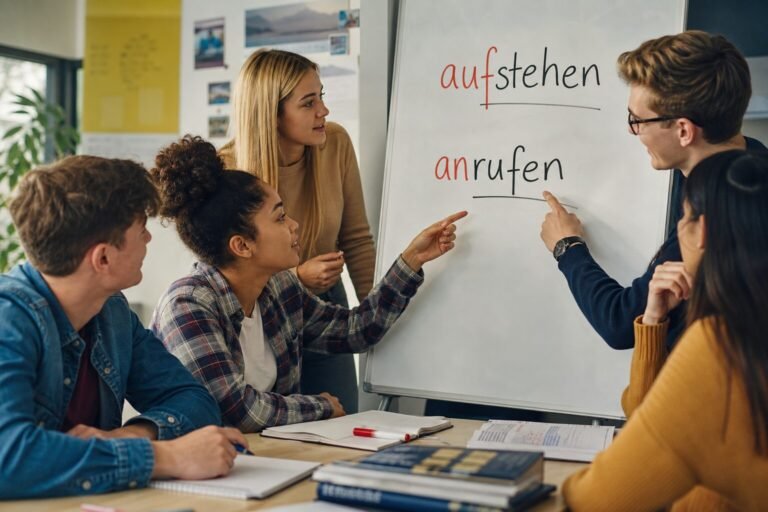
In this context, it is also worth reading our article on the topic of German separable verbs: aufstehen, anrufen and why the prefix jumps to the end.
None of this is a guarantee. German dictionaries, and most vocabulary apps, give you the plural form alongside every noun for exactly this reason: guessing gets you close, but for words you will use often, it is worth simply learning the plural by heart along with the word itself. For more information, you can visit this Wikipedia article.
Sounds and traps for English speakers
Two sounds cause trouble here, and neither exists in English. The umlaut ü, as in Bücher (books) or Häuser (houses), is made by rounding your lips as if to say „oo“ while trying to say „ee“ – it takes practice, and most English speakers need to hear it many times before their mouth produces it without thinking. The German ch, as in Mädchen (girl) or Bücher, is a soft, breathy sound with no real English equivalent; it is not „k“ and not „sh“.
Word order can also mislead you. In German, the plural article die (the) is identical for masculine, feminine and neuter nouns, which feels strange if you are used to English, where „the“ never changes for number or gender at all. So die Kinder (the children) and die Frauen (the women) use the same word for „the“ even though der Kind and der Frau would be wrong in the singular.
One more thing worth knowing, purely for English speakers: Gift in German does not mean „present“ – it means poison. Its plural, die Gifte (the poisons), turns up on cleaning products and in pharmacies, not on birthday cards. Wasser (water), by contrast, is a genuine shared word: same meaning, similar sound, and its plural, die Wasser or die Wässer (the waters), is rare in everyday speech since water is usually treated as uncountable, just as in English.
Sentences for the bakery and the office
Plurals show up constantly in ordinary transactions, so it helps to have a few ready-made sentences rather than building them from scratch under pressure. At the bakery, you might say: „Ich hätte gern zwei Brötchen“ (I would like two bread rolls) or „Können Sie mir drei Brote einpacken?“ (Can you pack up three loaves of bread for me?). Notice that Brötchen, being a diminutive, does not change in the plural, while Brote (loaves) does.
A related article covers the topic of German modal verbs: können, müssen, wollen and the sentence bracket.
At the Bürgeramt (residents‘ registration office), you will often need: „Ich brauche zwei Kopien meines Passes“ (I need two copies of my passport) or „Haben Sie die Formulare für die Anmeldung?“ (Do you have the forms for the registration?). At the doctor’s, a common one is: „Ich nehme keine Medikamente“ (I am not taking any medications) – Medikamente is already plural, and there is no singular ending -s to remove, unlike in English.
Getting the plural slightly wrong in these situations rarely causes confusion, but it can lead to some amusing misunderstandings. With practice and by paying attention to the patterns, you will become more confident in using German plural forms.
Frequently Asked Questions
What are the five endings for German plurals?
The five endings for German plurals are -e, -er, -(e)n, -s, and the Nullplural. Each ending corresponds to different noun types.
How can I guess the plural form of a German noun?
You can make educated guesses based on the noun’s ending and gender. For example, feminine nouns often add -(e)n.
Are there exceptions to the plural rules in German?
Yes, there are exceptions, especially with masculine and neuter nouns. It’s important to learn common patterns.
Why do English speakers struggle with German plurals?
English speakers may struggle due to unfamiliar sounds, such as umlauts and the German ch, as well as differences in word order.
How important is it to learn German plurals?
Learning German plurals is crucial for effective communication, especially in everyday situations like shopping or at the doctor’s.
* Affiliate link – we may receive a commission at no extra cost to you.